
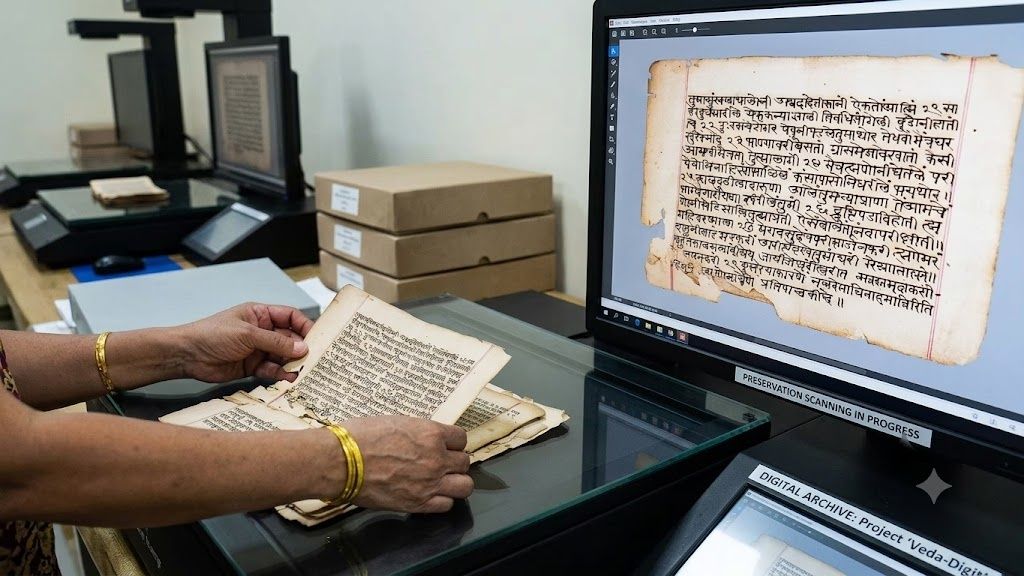

Hidden inside libraries, monasteries, temples, and private collections across India are thousands of manuscripts carrying the story of a civilisation that has evolved over centuries. Written on palm leaves, birch bark, and handmade paper, these fragile texts preserve knowledge on Ayurveda, astronomy, mathematics, philosophy, literature, governance, and traditional practices. Yet, time, climate, and neglect continue to threaten their survival.
India's latest preservation effort has brought renewed hope. Under the Gyan Bharatam Mission, the country has identified more than 1.2 crore manuscripts, marking a significant milestone in safeguarding one of the world's richest knowledge traditions.
More Than Digitisation, A National Commitment
The milestone was highlighted during the National Digitization Drive Workshop organised by the Ministry of Culture in New Delhi, where over 200 representatives from States, Union Territories, research institutions, technology experts, and manuscript custodians discussed building a unified digital ecosystem for India's manuscript heritage.
Describing the achievement as a coordinated national effort, Union Culture Minister Gajendra Singh Shekhawat credited the collaboration between States, Union Territories, research centres, ministry officials, and custodians for reporting over 1.2 crore manuscripts. He said the mission reflects a collective resolve to honour India's intellectual legacy by identifying, categorising, preserving, and publishing these works so they can continue to benefit future generations.
The initiative gained further momentum with the launch of the Gyan Bharatam Portal by Prime Minister Narendra Modi, creating a digital archive that aims to preserve, digitise, and make these manuscripts accessible to researchers, students, and the public.
Why This Mission Matters?
India's manuscripts are far more than historical records; they are repositories of knowledge that have shaped medicine, science, mathematics, philosophy, literature, and cultural traditions. Ancient Ayurvedic texts, astronomical observations, grammatical treatises, and philosophical writings continue to hold immense academic and historical value.
Digitisation offers multiple benefits. It protects fragile originals from repeated handling, enables researchers across the world to access rare collections remotely, encourages translation and interdisciplinary research, and allows younger generations to reconnect with India's intellectual heritage through digital platforms.
Preserving Knowledge, Not Just Pages
Technology can preserve manuscripts, but preserving their true value requires historians, linguists, archivists, and scholars who can interpret ancient scripts and place them in their historical context. Without this human effort, digital archives risk becoming collections of scanned pages rather than living sources of knowledge.
The National Digitization Drive's vision of building an AI-enabled manuscript ecosystem is therefore an important step forward. If combined with sustained research, conservation, and public engagement, the Gyan Bharatam Mission can bridge India's ancient wisdom with the digital age, ensuring that centuries of knowledge are not merely stored, but understood, shared, and carried into the future.
Because preserving history is not simply about protecting the past, it is about ensuring its wisdom continues to inspire the future.