

New Delhi: Artificial intelligence is not merely advancing, it is accelerating at a pace that is redrawing economies, labour markets, geopolitics, and knowledge systems, according to the Artificial Intelligence Index Report 2026, released by the Stanford Institute for Human-Centered AI at Stanford University.
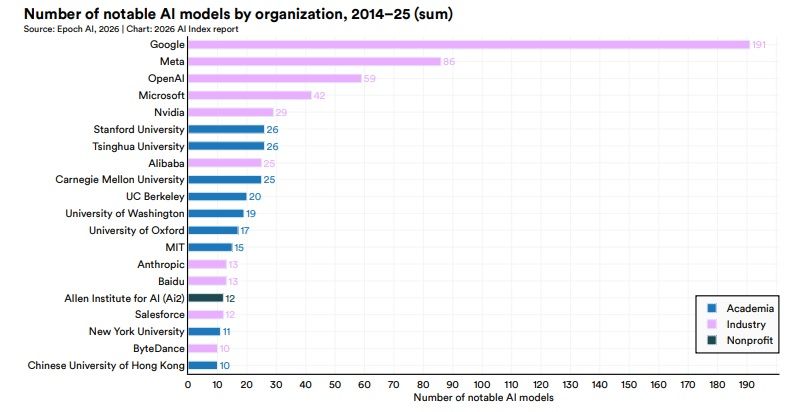
AI capability is not plateauing; it is scaling rapidly, reaching deeper into everyday life while simultaneously pushing the boundaries of what machines can achieve. Industry now produces over 90% of notable frontier AI models, signalling a decisive shift away from academia-led innovation. More strikingly, several of these models now match or exceed human performance on PhD-level science questions, complex multimodal reasoning, and competition mathematics.
The speed of progress is perhaps best captured by a single benchmark. On SWE-bench Verified, a key coding evaluation, AI systems moved from 60% to nearly 100% of the human baseline in just one year. Such leaps are not incremental; they are transformative, the report points out.
AI’s adoption mirrors this acceleration. Organisational uptake has reached 88% globally, while four out of five university students now use generative AI tools. For India, where higher education enrolment is expanding and digital infrastructure is uneven, this signals both an opportunity to leapfrog and a risk of widening inequality. AI is no longer a specialised tool but a foundational layer of modern life.
Fastest Tech Adoption in History
If the rise of the internet reshaped societies over decades, generative AI is doing so in years. The report finds that generative AI reached 53% population adoption within just three years, outpacing both personal computers and the internet itself. This is historically unprecedented.
Yet the adoption story is uneven, and here lies a critical insight for India. The pace of uptake correlates strongly with GDP per capita, suggesting that economic capacity still determines access to transformative technologies. Countries like Singapore, with 61% adoption, and the United Arab Emirates at 54%, outperform expectations, while the United States ranks only 24th at 28.3%.
This unevenness raises questions about India’s trajectory. With its vast population and growing digital ecosystem, India could emerge as a major AI user base. However, disparities in income, connectivity and digital literacy could create pockets of exclusion.
What is undeniable is the value users derive. In the United States alone, generative AI tools (many of them free) are estimated to deliver $172 billion annually in consumer value as of early 2026. The median value per user has tripled between 2025 and 2026, underscoring how quickly these tools are becoming indispensable.
For Indian households, where affordability is a decisive factor, the availability of high-value, low-cost AI tools could be transformative. From education and healthcare to small business productivity, the potential is immense. But the report also hints at a deeper challenge: access alone does not guarantee meaningful use.
Jobs, Productivity & Uneven Economic Shock
Perhaps the most consequential section of the report, particularly for India, lies in its examination of labour markets. AI-driven productivity gains are real and measurable. Studies cited in the report show improvements ranging from 14% to 26% in customer support and software development.
However, these gains are not evenly distributed. Tasks requiring structured processes benefit the most, while those demanding judgment show weaker or even negative effects. This divergence has profound implications for a country like India, where large segments of the workforce are engaged in routine or semi-structured roles.
Even more concerning is the emerging pattern in employment. In the United States, software developers aged 22 to 25 saw employment fall nearly 20% from 2024, even as older developers continued to see growth in headcount. This suggests that entry-level roles are being squeezed.
For India, with millions entering the workforce annually, this trend cannot be ignored. The country’s IT services sector, long a pillar of economic growth, may face structural shifts as AI automates entry-level coding and support tasks.
At the same time, AI agent deployment remains in single digits across most business functions. This indicates that while the technology is powerful, its integration into workflows is still in early stages. The window for adaptation remains open, but not indefinitely.
The report underscores a paradox: AI is boosting productivity while simultaneously reshaping who gets to participate in that productivity.
Power, Politics & Global AI Race
Beyond economics, the report maps a rapidly evolving geopolitical landscape. The United States continues to dominate in AI investment, pouring $285.9 billion into private AI ventures in 2025 — more than 23 times China’s $12.4 billion. It also leads in entrepreneurial activity, with 1,953 newly-funded AI companies in a single year.
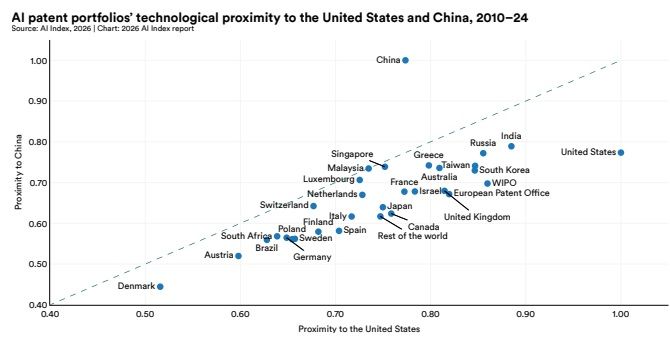
Yet this dominance is not absolute. The report notes that the US-China performance gap in AI models has effectively closed. Since early 2025, leadership has shifted back and forth, with Chinese models briefly matching top US systems and the latest American model leading by just 2.7%.
China, meanwhile, leads in publication volume, citations, patent output, and industrial robot installations. South Korea emerges as a standout in innovation density, leading the world in AI patents per capita.
A critical vulnerability also comes into focus. The United States hosts 5,427 data centres (more than 10 times any other country) and consumes more energy than any other nation for AI infrastructure. Yet almost every leading AI chip is fabricated by a single Taiwanese company, TSMC, creating a concentrated and fragile supply chain.
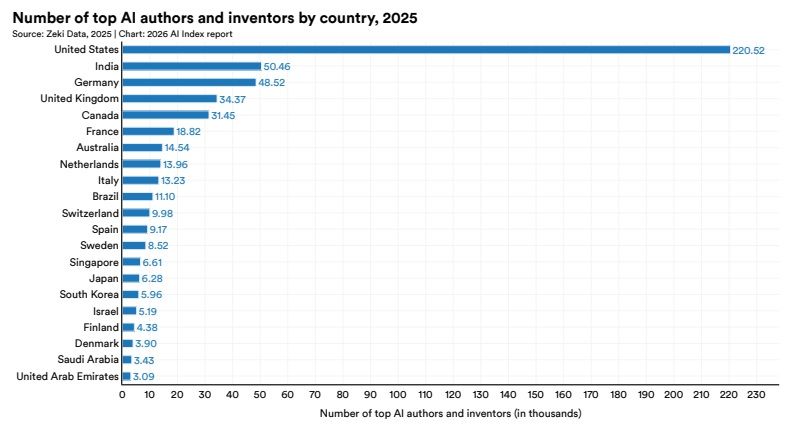
For India, which aspires to technological sovereignty, these dynamics are instructive. The global AI ecosystem is increasingly defined by concentration of capital, talent, and infrastructure. The report notes a sharp decline in the United States’ ability to attract global AI talent, with an 89% drop since 2017 and an 80% decline in the last year alone.
This presents an opening. India, with its large pool of engineers and expanding startup ecosystem, could position itself as a talent hub, provided it invests in research, education, and policy clarity.
Promise, Peril & Unfinished Future
Even as AI achieves extraordinary feats, the report highlights its limitations and risks. It describes a “jagged frontier”, where systems can win a gold medal at the International Mathematical Olympiad yet struggle to read an analog clock correctly just 50.1% of the time.
Similarly, AI agents have improved their success rate on real-world computer tasks from 12% to around 66%, but they still fail one in three attempts. Robots, often seen as the next frontier, succeed in only 12% of household tasks despite achieving 89.4% success in controlled simulations.
In science, AI models are beginning to outperform human experts in fields like chemistry, yet they falter in areas such as astrophysics and Earth observation. Notably, smaller, specialised models are sometimes outperforming much larger systems, challenging the assumption that scale alone drives progress.
Healthcare offers both promise and caution. AI tools that generate clinical notes have reduced physicians’ documentation time by up to 83%, significantly lowering burnout. However, rigorous evidence remains limited. Nearly half of over 500 clinical AI studies rely on exam-style questions rather than real patient data, and only 5% use actual clinical data.
The environmental cost is another growing concern. Training a single advanced model can generate emissions equivalent to 72,816 tons of CO2. AI data centre power capacity has reached 29.6 GW, comparable to peak demand in New York state, while water usage for AI operations is reaching staggering levels.
Perhaps most troubling is the gap between capability and responsibility. Documented AI incidents have risen sharply to 362 from 233 in 2024, while reporting on safety benchmarks remains inconsistent. The report notes that improving one aspect of responsible AI, such as safety, can degrade another, such as accuracy.
Public trust is also fragmented. While 73% of experts believe AI will positively impact jobs, only 23% of the public shares that view. Trust in governments to regulate AI varies widely, with the United States reporting the lowest confidence at 31%, while the European Union enjoys comparatively higher trust.
For India, these findings underscore a central truth: the AI revolution is not just about technology. It is about governance, trust, and societal readiness.
India’s Moment of Decision
For India, the stakes are uniquely high. With its demographic scale, digital ambition, and developmental challenges, the country stands at a crossroads. It can either harness AI as a force multiplier for growth and inclusion or risk deepening existing inequalities.
What the report ultimately reveals is not just the trajectory of AI, but the urgency of human response. The question is no longer whether AI will transform the world. It already is. The real question is whether countries like India are prepared to shape that transformation… or be shaped by it.
(Cover photo by Igor Omilaev on Unsplash)