
New Delhi: The World Economic Forum’s Growth in the New Economy report arrives at a moment of profound global churn, where the old certainties of growth — cheap capital, predictable trade flows and stable geopolitics — have fractured. In their place emerges a more complex, technology-driven, sustainability-conscious and fragmented economic landscape. The report’s central thesis is stark: growth is no longer automatic, it must be engineered through productivity, resilience and inclusion.
The WEF report underlines that a “convergence of deep structural transformations… is shaping the contours of the new economy”, citing the acceleration of AI, rising geostrategic competition, demographic shifts and environmental recalibration. This is not a cyclical slowdown; it is a systemic transition. Compounding this shift is what the report describes as a “sustained slowdown of growth and deepening economic divides”, raising fundamental questions about the durability of existing growth models.
India enters this turbulent moment with relative strength. As advanced economies grapple with stagnation and policy fatigue, India’s growth trajectory — hovering around 6-7% — positions it as a rare bright spot. Yet the WEF report’s framework suggests that momentum alone is insufficient. Growth in the new economy must be resilient, inclusive and productivity-driven.
Crucially, the report notes that “the winners in the new economy will be those who understand competing threats and opportunities and build agile growth pathways”. This insight resonates deeply with India’s current position. The country is navigating multiple transitions simultaneously — formalisation, digitalisation industrial expansion and climate adaptation. Each presents opportunity, but also risk.
India’s challenge, therefore, is not merely to sustain growth, but to align it with the structural demands of the new economy. The WEF report implicitly positions India as a test case: can a large, diverse emerging economy translate structural shifts into durable, high-quality growth?
Technology, Productivity & Digital Leap
At the heart of the WEF report lies an assertion that “sustained growth in the new economy is anchored in ‘no-regret’ moves that strengthen productivity and human capital as technology and knowledge become central to value creation”. This is where India’s digital transformation assumes global significance.
India’s digital public infrastructure, spanning identity (Aadhaar), payments (UPI) and data, has redefined inclusion and efficiency. The scale is unprecedented, with billions of transactions flowing through low-cost systems that have brought millions into the formal economy. The WEF report’s emphasis on productivity gains through technology finds a natural parallel in India’s experience.
However, the report also frames a critical tension: how to translate innovation into broad-based growth. It points to the need to navigate “different approaches to translating innovation into new sources of growth (competition vs coordination)” and ensuring benefits are “widely shared (mobility vs redistribution)”. For India, this is a live policy dilemma.
While digital systems have expanded access, disparities persist. Rural connectivity gaps, uneven digital literacy and gender divides risk limiting the transformative potential of technology. The WEF report’s caution that benefits must be widely shared underscores a key vulnerability in India’s growth story.
Human capital emerges as another decisive factor. As AI and automation reshape labour markets, India’s demographic dividend will depend on its ability to upskill its workforce at scale. The report’s focus on knowledge as a driver of value creation places education and skilling at the centre of economic strategy.
There is also an implicit warning. Technology-led growth can exacerbate inequalities if not managed carefully. India’s digital success, while impressive, must be complemented by policies that ensure inclusion, resilience and security. In the WEF report’s framework, digital infrastructure is not an end in itself, it’s a foundation that must be leveraged wisely.
Global Shifts, Supply Chains & India’s Strategic Opening
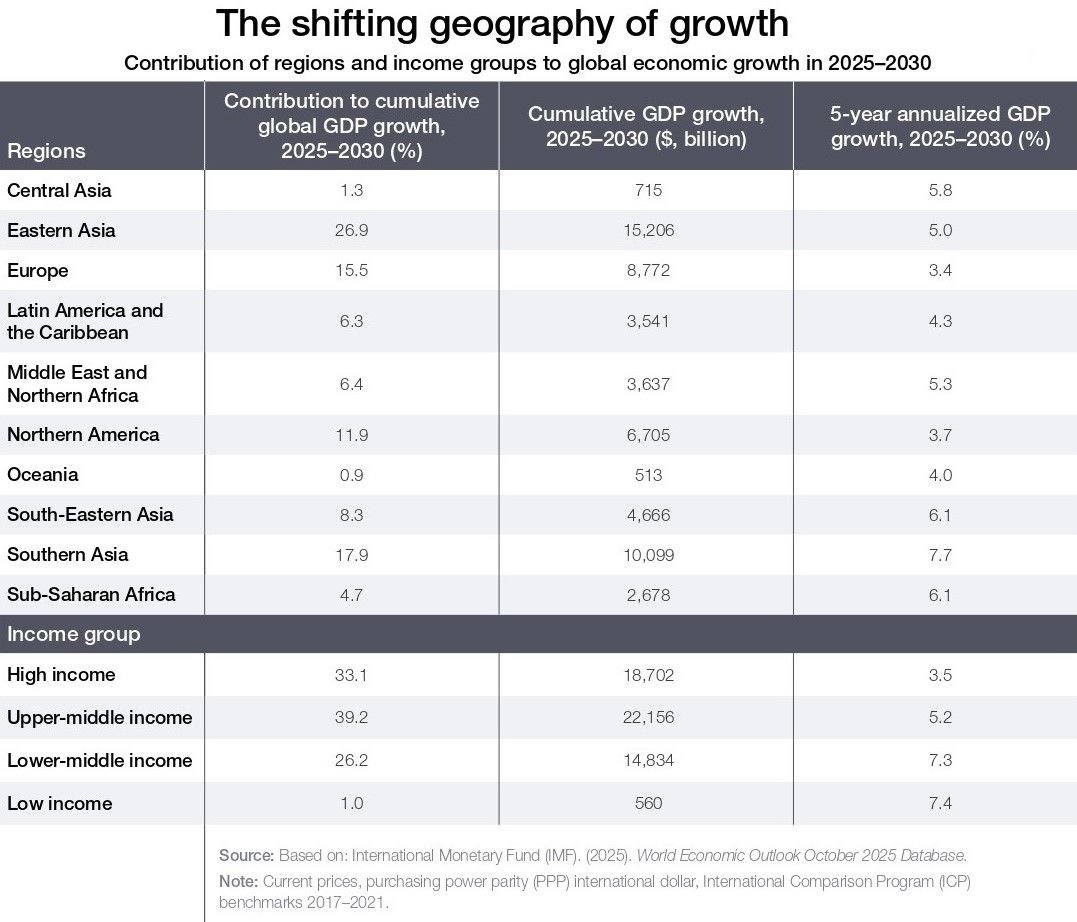
The WEF report’s second pillar — global cooperation and domestic capacity — captures the shifting dynamics of trade and geopolitics. It argues that “leveraging comparative advantage and diversification are among the ‘no-regret’ moves” that can drive growth and resilience.
For India, this insight arrives at a moment of opportunity. Global supply chains are being reconfigured in response to geopolitical tensions and disruptions. The report references how such shocks “threaten to cause further economic scarring and heighten uncertainty about the future trajectory of growth”. In this environment, diversification is no longer optional; it is strategic.
India’s ambition to position itself as a manufacturing hub aligns with this shift. Initiatives aimed at boosting domestic production and attracting global investment reflect an attempt to leverage comparative advantage, particularly in labour and market size. Yet the WEF report introduces a crucial balancing act. “How governments and businesses balance global engagement with the strengthening of domestic capacity… will shape the global geo-economic and growth landscapes,” it says.
This tension is visible in India’s policy choices. Efforts to integrate into global value chains coexist with a push for self-reliance. The report frames this as a broader dilemma between “self-reliance and global integration strategies”, suggesting that neither extreme is sufficient.
Infrastructure, logistics and regulatory efficiency remain critical constraints. While India has made progress, gaps persist that affect competitiveness. The WEF report’s emphasis on diversification also implies that India must move beyond traditional sectors and build capabilities in emerging industries, including green technologies and advanced manufacturing.
Geopolitically, India’s relative stability enhances its appeal as a partner. In an era of fragmented globalisation, the ability to navigate multiple alliances without overdependence is a strategic advantage. Yet, as the WEF report suggests, sustaining this position will require consistent policy signals and institutional credibility.
Sustainability, Inclusion & Hard Questions of Growth
On sustainability and economic policy, the WEF report redefines the very purpose of growth. “Focusing on the economic and societal benefits of green transition strategies is essential to unlocking long-term prosperity and resilience,” it says.
For India, this is both an opportunity and a constraint. The country must expand its economy while simultaneously reducing its environmental footprint. This dual objective creates what the report describes as “critical dilemmas around how to manage the costs and trade-offs of greener growth”.
India’s investments in renewable energy, electric mobility and sustainable infrastructure signal intent. However, the scale of financing required (often in dollars) and the need for technological adaptation present formidable challenges. The WEF report highlights that decision-makers must navigate “investment-led and cost-led strategies”, a choice that carries significant implications for fiscal policy and growth.
Inclusion adds another layer of complexity. The report’s broader concern about “deepening economic divides” is particularly relevant for India, where disparities across regions and income groups remain pronounced. Growth that is not inclusive risks being politically and socially unsustainable.
The role of government becomes central in this context. The WEF report emphasises “reinforcing the fundamentals of economic policy — including credible institutions, high-quality infrastructure and macroeconomic stability.” It also points to the dilemma between a “small” and “bold” government, as well as the challenge of managing rising public debt in a slower-growth environment.
For India, these are not abstract debates. Fiscal constraints, welfare demands and investment needs must be balanced carefully. The credibility of institutions and the efficiency of governance will determine how effectively policies translate into outcomes.
Ultimately, the WEF report’s framework suggests that growth in the new economy is as much about choices as it is about capabilities. India’s trajectory will depend on how it navigates these trade-offs: between speed and sustainability, scale and inclusion, autonomy and integration.
India’s Decisive Decade
The WEF report lays out a set of “tensions” that will define the future of growth. For India, these tensions are particularly acute.
The report’s key message that growth must be “deliberate, adaptive and inclusive” resonates strongly with India’s current phase of development. The country has the building blocks: a young population, digital infrastructure and growing global relevance. But the path ahead requires navigating complex trade-offs with precision.
Success will belong to those who can “build agile growth pathways”. For India, this is not just an economic imperative, it’s a defining test of its emergence as a leading force in the new global order.
The decade ahead will decide whether India’s promise translates into lasting prosperity.
(Cover photo by Joshua Rawson-Harris on Unsplash)