


New Delhi: The rapid ascent of AI is no longer a distant forecast for the global workforce; it’s a present, measurable force reshaping how people work, learn and plan their futures. And nowhere is this transformation more intense than in India, where the scale, speed and psychological impact of AI-led disruption are setting the tone for what the future of work looks like worldwide.
The 2026 ETS Human Progress Report, based on responses from more than 32,000 workers across 18 countries, paints a picture of a labour market in constant flux. One where adaptation is no longer optional and stability has been fundamentally redefined.
India stands at the epicentre of this AI-led shift. An overwhelming 86% of Indian workers report experiencing major workplace changes in the past 12 months, far exceeding the global average of 67%, says the report. This places the country among the most disrupted labour markets globally, alongside emerging economies where technological acceleration is leapfrogging traditional stages of development. The disruption is not confined to isolated changes such as automation or layoffs. It’s structural and simultaneous, affecting the tools employees use, the skills they need, and the expectations placed upon them.
Globally, 43% of workers say workplace technology has changed significantly, while 41% report shifts in job responsibilities, according to the ETS report. In India, these changes are happening with greater intensity, creating a compounding effect where employees must constantly “relearn, reorient and requalify” just to remain effective in their roles. This has given rise to what many describe as a state of “perpetual catch-up”, where the pace of change outstrips the ability to adapt comfortably.
AI Surge
This relentless transformation has established a unique psychological baseline among Indian workers. One that is defined by ambition intertwined with anxiety. A striking 67% of employees in India report experiencing what is now widely termed ‘Fear of Becoming Obsolete’ or FOBO. This is notably higher than the global average and reflects a workforce acutely aware of how quickly skills can lose relevance in an AI-driven environment.
The concern is not abstract. Across the world, 44% of workers say their job requirements are changing faster than they can learn new skills, while 42% struggle to keep up with emerging technologies. In India, where digital transformation is sweeping across sectors from information technology to manufacturing and finance, this mismatch is especially pronounced, reveals the survey. Workers find themselves learning new tools while simultaneously performing their existing roles, creating a constant state of “learning in motion”.
Yet, what distinguishes India is not just the intensity of disruption, but the response to it. Despite elevated anxiety levels, Indian workers are among the most proactive globally. An extraordinary 89% report actively developing new and diverse skills to safeguard their careers, compared to a global average of 77%. This proactive mindset aligns with what the report identifies as ‘Adaptive Thrivers’ — individuals who face high levels of disruption but retain confidence in their ability to adapt and succeed.
In fact, the drive for relevance in India has reached a point where traditional notions of job security are being replaced altogether. About 72% of workers say they have shifted from seeking stability to focusing intensely on staying relevant. Globally, a similar shift is underway, with 61% of workers prioritising relevance over security. This marks a profound change in the social contract of employment, where longevity with a single employer no longer guarantees stability.
At the heart of this transformation lies a widening skills gap, particularly in AI. While 65% of workers worldwide recognise AI literacy as highly important, only 46% feel proficient in it, resulting in a 19-point gap — the largest across all measured competencies. This gap highlights a workforce that understands the importance of AI but lacks the capability to engage with it effectively.
In India, this gap is fuelling what can be described as a “credential revolution”. Roughly 87% of workers believe they must benchmark their skills against industry peers to remain competitive. An even larger 92% say that university education would be significantly more relevant if it included a formal “skills credential transcript” alongside traditional academic records. The emphasis is shifting from degrees alone to verifiable, continuously updated proof of skills.
However, access to such credentialing remains uneven. Globally, while 73% of workers express interest in credential programmes, only 45% have access to them. This 27-point gap represents a significant structural bottleneck. In India, the challenge is compounded by affordability concerns, with 83% of workers worried about the cost of training required to stay competitive.
Global Shifts
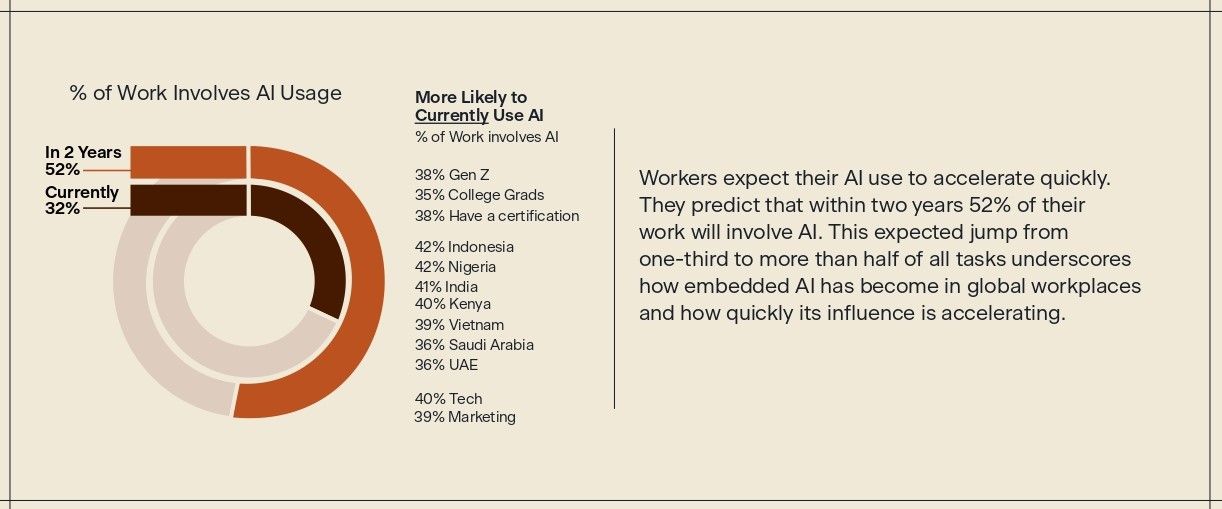
Although India represents the sharpest edge of disruption, the broader global workforce is moving along a similar trajectory. Across all surveyed countries, 77% of workers now believe that job security no longer exists without continuous evolution. Employees predict that within the next two years, 50% of all work will involve AI, signalling a fundamental redefinition of job roles where human tasks are increasingly intertwined with machine capabilities.
This transformation has given rise to three distinct workforce mindsets.
- Adaptive Thrivers: who make up 41%, embrace change with confidence.
- Anxious Learners: accounting for 39%, recognise the need to adapt but feel uncertain about how to proceed.
Paralyzed Pessimists: Comprising 20%, feel overwhelmed and unsupported by the pace of change.
India skews heavily toward the first category, reflecting high resilience despite intense disruption. In contrast, regions such as Western Europe and Eastern Asia show higher concentrations of pessimistic workers, with countries like South Korea reporting as many as 33% in this category.
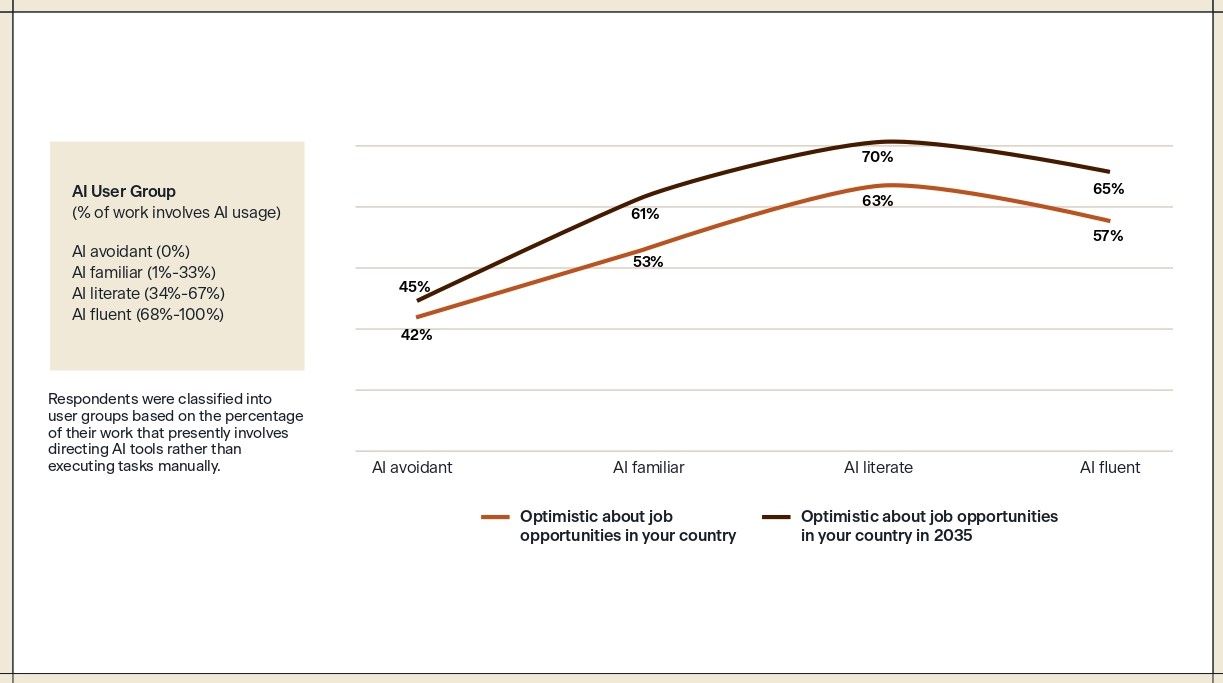
The divide between those who can adapt and those who cannot is becoming increasingly pronounced. Workers with AI experience consistently report higher optimism about their career prospects, while those without such exposure fall into ‘AI-anxious’ segments. This emerging divide is creating a new form of inequality. One that is defined not just by education, but by access to technology and opportunities for upskilling.
Barriers to adaptation are widespread and multi-faceted. Globally, 93% of workers report facing at least one obstacle to professional success. Beyond cost, one of the most significant challenges is a lack of clarity. Around 70% of workers say they find it difficult to determine which AI credentials are recognised and valued by employers. This “credibility gap” discourages investment in training, with 31% citing a lack of trusted providers as a key barrier. In middle-income countries like India, this figure rises to 38%, underscoring the need for standardised and portable certifications.
Institutional support also remains inconsistent. While 88% of workers expect their employers to provide upskilling opportunities, only 71% actually receive such support. This gap is particularly critical in India, where the scale and diversity of the workforce make coordinated efforts more challenging. As a result, there is near-universal demand for government intervention. An overwhelming 97% of Indian workers believe that public institutions should fund or support workforce readiness programmes to bridge the growing divide.
The uncertainty extends beyond immediate job roles to the future of work itself. Globally, 69% of workers say they have no clear understanding of what jobs will look like by 2035, and nearly half feel unprepared for next-generation roles. In India, where technological change is both rapid and uneven, this uncertainty is even more pronounced.
What emerges from the data is not merely a story of disruption, but of systemic transformation. AI is not simply replacing jobs; it is redefining them at a pace that institutions are struggling to match. Workers are adapting, often with remarkable resilience, but frequently without clear guidance, sufficient support or reliable pathways to validate their skills.
For India, the stakes are particularly high. The combination of intense disruption, widespread anxiety and strong motivation to upskill creates a workforce that is both highly dynamic and deeply vulnerable. Success in this environment depends not on what individuals know at a given moment, but on how quickly they can learn, adapt and prove their capabilities.